
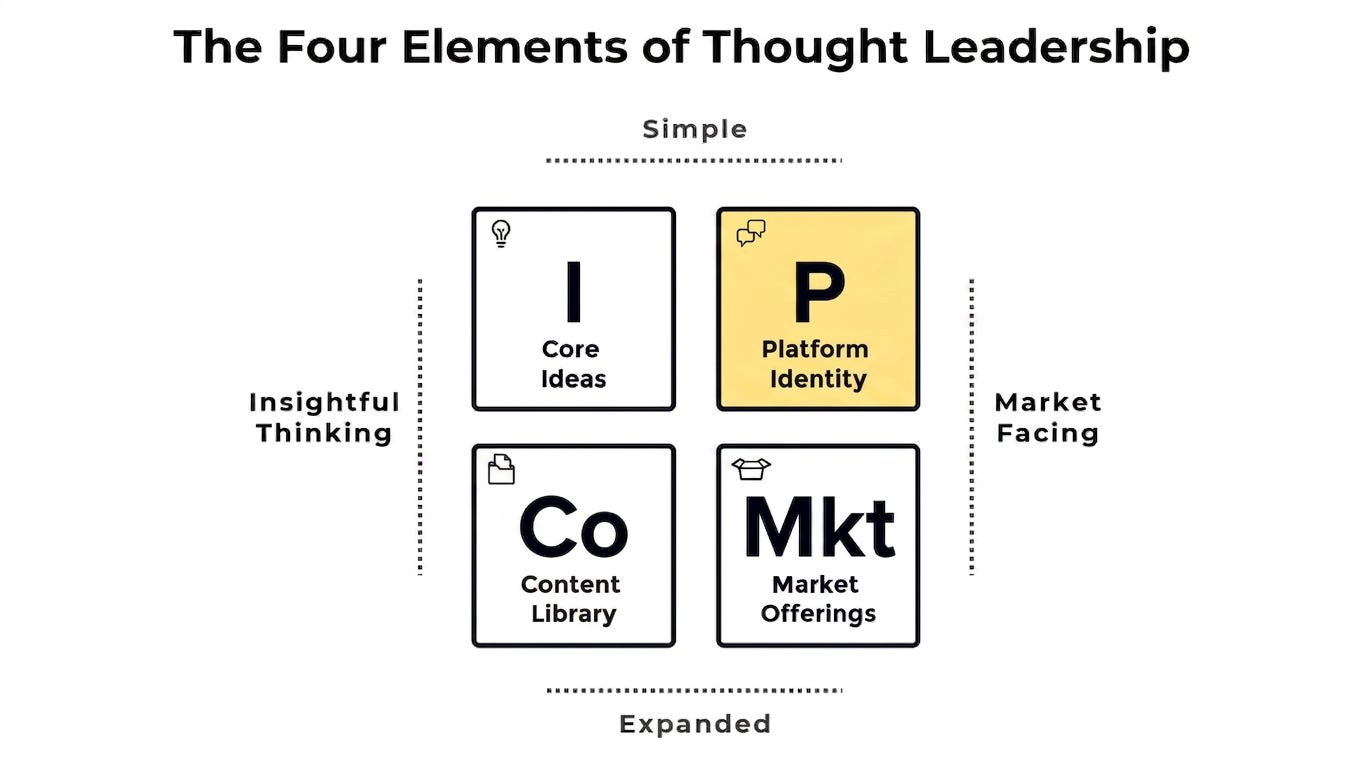
What is a platform identity in thought leadership?
You’ve seen corporate brands and product brands. You may have even built a personal brand for yourself. A platform identity is the brand for your ideas. It’s how people describe your ideas when you’re not in the room.
Why do I need a platform identity?
Ideas need a brand. If they don’t have one of their own, they will latch onto the closest brand available (either your personal brand or that of your company). You might feel good when people attribute your ideas to you: “hey, people like my ideas. That’s cool.” But if you want your ideas to travel and make an impact, your ideas need to be able to stand on their own and travel without you. You need to make yourself less central to the ideas.
Do I need a brand for my ideas?
In our experience, many thought leaders neglect the platform identity work. They make it difficult for others to talk about the ideas, and so the ideas travel less than they might.
When a thought leader tells us they thought the ideas would have created greater impact, it’s very likely that they have not invested much effort into curating their platform identity. And it’s become a significant blocker to the velocity of their ideas.
Does a platform identity mean I need a logo and colors for my ideas?
No. Your ideas might someday have a visual brand with logo, fonts, and colors. But those pieces are not part of a platform identity. If someone asks you, “What is Nike?” you’re unlikely to reply “swoosh.” You’ll talk about their gear, their campaigns, their support of athletes. If someone asks you to describe a friend’s professional style, you might say “prompt, creative, and persistent.”
What makes a good platform identity?
A platform identity for thought leadership has a few characteristics:
Concise: just a few words (shorter than your core idea)
Clear: no technical terms or jargon.
Signals what it solves: your target audience sees relevance in five seconds or fewer.
Distinctive: the platform identity isn’t used by anyone else
How do I create a platform identity for my ideas?
You can influence a platform identity, but ultimately, it’s a brand that is owned and defined by your target audience (and especially your fans). They decide how they will explain your ideas in their own words. You can equip people with language, but you cannot make them use it.
That’s the paradox of all brands (corporate, product, personal, and idea). You can suggest language, you can be consistent with the language you use. But you might be surprised by how others choose to describe your ideas.
If ideas lack a strong platform identity, what happens?
The ideas don’t travel on their own. People struggle to explain them to their friends and colleagues. And people are unlikely to bring up ideas they can’t explain comfortably.
You may also see a wide drift between how you perceive your ideas and how others perceive your ideas. Either you need to accept their language or you need to send stronger signals for a platform identity.
How do I know if my platform identity is strong or weak?
In The Thought Leadership Handbook, we provide a set of questions you can use to evaluate your platform identity. In short, you answer the questions yourself in writing. Then, you ask others to answer the same questions. And you look for differences in the answers.
What clues should I listen for?
Here are a few of the signals that your platform identity might be weak or misaligned:
People cite you more often than the ideas (signals stronger personal brand than platform identity).
People use different terms and language to describe your core ideas.
You wince when others explain your core ideas wrongly.
Your audience can’t tell that your core ideas are for them.
Where can I learn more about building a platform identity?
You’ll find more information (including stories and case studies) in Chapter 4 of The Thought Leadership Handbook by Bill Sherman, Peter Winick, and Naren Aryal. The book also contains tools to help you create and monitor your platform identity.
Where Can I Learn More About Bill Sherman’s Four Elements of Thought Leadership?
This article is the fourth of four about the Four Elements of Thought Leadership here on Substack.
Read the third article about market offerings.
You can also find more articles for Bill Sherman’s Four Elements of Thought Leadership framework on its canonical page
.